

27 Best Things to Do in Charlottesville (that are also fun)
Charlottesville can look pretty serious on paper. Thomas Jefferson. James Monroe. The University of Virginia. More than two centuries of architecture and history to work through.
But that's only part of a Charlottesville trip. You can walk through a mountain (yes, literally through it), eat a cider donut from a 1,100-foot ridge overlooking the valley, paddle the Rivanna River, stomp divots at a polo match, catch live music downtown and, yes, ride a bicycle through wine country.
I'm the owner of Shifting Gears, so I'm admittedly partial to that last one. But the point of this list isn't to convince you to do what I like. It's to help you figure out which parts of Charlottesville and the surrounding countryside sound like the most fun to you.
In this post
Charlottesville Experiences to Start With
1. Tour Thomas Jefferson's Monticello
I don't think Monticello should be treated as one of those famous places you visit simply because you're supposed to. There's too much going on here for that.
Start with the house itself. There's the octagonal dome, the porticoes, light wells and a surprising number of Jefferson's mechanical inventions (the Great Clock is really cool). The two-acre terraced kitchen garden grew European and Native American plants as part of Jefferson's botanical experimentation.
And don't let the famous house swallow the larger story. Mulberry Row shifts attention toward the enslaved men, women and children who built, maintained and operated the plantation, including members of the Hemings, Granger and Gillette families.
The standard Highlights Tour takes about 45 minutes, but I'd give Monticello two or three hours. There's more here than one lap through Jefferson's rooms. You can even combine a hike with your visit by parking at the base of the Saunders Monticello Trail, and hiking all the way up to Thomas Jefferson’s home perched high on the hill. The trail up to the Monticello visitor center is covered in crushed stone, wooden boardwalks, or paved the entire way. At 5 miles round-trip, and never exceeding a 5% grade, this hike is well suited to most everyone who likes to take walks.
Best by: Walk or Car | Plan for: 2–3 hours | Admission: $42/adult | Budget: About $42–$55 per person
2. Walk UVA's Lawn and Step Inside the Rotunda
Thomas Jefferson wasn't finished designing things after Monticello.
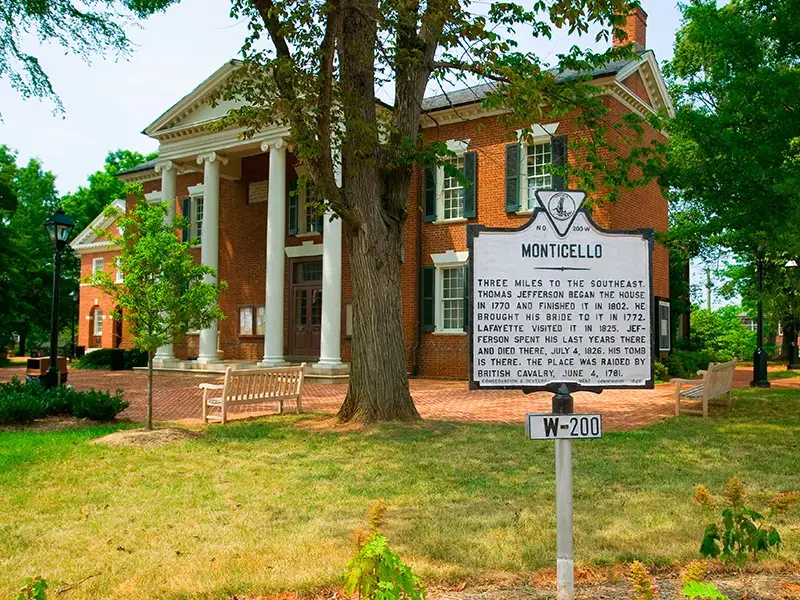
He founded the University of Virginia (UVA) in 1819 and conceived its historic center as an "Academical Village," with students and professors arranged around a long central Lawn. The Rotunda, modeled on Rome's Pantheon at roughly half scale, gets most of the attention, but don't make it the only thing you look at. The ten pavilions use different classical orders, and the serpentine brick walls are one of those architectural details that are more fun once somebody points them out.
UVA and Monticello share UNESCO World Heritage status. If you're interested in Jefferson's architecture, it makes sense to see both.
An hour is enough for an unhurried walk through the Lawn and Rotunda.
Best by: Walk or car | Plan for: 45–90 minutes | Admission: Free | Budget: $0–$10 per person, plus parking if needed

3. Spend Some Time on the Historic Downtown Mall
After Monticello and UVA, the Downtown Mall puts you back in present-day Charlottesville.
Eight blocks of red brick are closed to regular traffic and lined with mature willow oaks and honey locusts, more than 120 shops, roughly 30 restaurants, bookstores, galleries, theaters and outdoor tables. Landscape architect Lawrence Halprin helped plan the pedestrian conversion in the 1970s. I just love looking at the old storefronts, mature trees and all the little details you miss when you're driving through a city at 35 miles per hour.
I wouldn't over-plan this one. Browse a bookstore. Get lunch. Find the Community Chalkboard, a two-sided slate wall devoted to the First Amendment. Sit outside for a while. Come back after dark if there's a show.
An hour works, but it's very easy for an hour to become three.
Best by: Walk or car | Plan for: 1–3 hours | Admission: Free | Budget: About $20–$60+ per person
4. Ride to Wineries with Shifting Gears Travel
I'm obviously biased here. I own Shifting Gears. But I'm also including it because riding through Charlottesville wine country gives you a very different experience than driving from one tasting room to the next.
The guided ride covers roughly 18 miles on paved rural roads using regular fitness bikes or step-through e-bikes, typically with stops at two independent estate wineries. Between them are Piedmont foothills, vast equestrian estates, and working vineyards rather than another stretch of windshield time in a smelly bus.
The wineries are important, but a lot happens between them. It’s easy to think the wineries are the whole point. They're not, at least not to me. The bike helps us see the area in a whole new light, but then it’s the education that you’ll get from your guide that really puts this experience over the top. As the guest reviews attest, I think what you’ll walk away with is a unique experience your friends haven’t had, and a fresh perspective on wine that you’ll be sure to share at your next get together.
We sit down to a robust healthy lunch, taste at two wineries, ride through the vineyard alongside sheep and pollinators, and the support vehicle follows along with water, delicious local snacks, and room for the special bottles that you buy along the way.
Plan on roughly six hours. Make this the day, not the thing you try to squeeze between three more wineries.
Best by: Car + bike | Plan for: About 6 hours | Tour price: $195

5. Walk Through the Blue Ridge Tunnel
Here's one I like recommending because the premise is so good: instead of hiking over the mountain, you walk through it!
The Blue Ridge Tunnel runs 4,273 feet beneath Rockfish Gap. Irish immigrant miners and leased enslaved laborers helped excavate it in the 1850s with only hand drills and black powder (it took them eight years). When it was completed, it was the longest railroad tunnel in the United States.
Inside, there are no scenic overlooks to distract you. Rock, darkness, dampness and water seeping through the ceiling are the experience. Temperatures stay roughly between 55 and 65 degrees year-round.
My practical advice is simple. Bring a flashlight or headlamp, and maybe a few ghost stories. The east approach is the better choice for accessible access, although the tunnel floor can still be irregular. Allow about 1 1/2 to 2 hours.
Best by: Car + walk | Plan for: 1½– 2 hours | Admission: Free | Budget: $0 per person, not including transportation of course

6. Pick Apples and Eat a Cider Donut at Carter Mountain
You can make a strong case for visiting Carter Mountain on the cider donuts alone. They’re soooo good.
They're fried on-site and rolled in cinnamon sugar. Add hot cider or a cider slushie, then look out from the roughly 1,100-foot ridge toward Charlottesville, UVA and the Blue Ridge. Absolutely stunning views. There's also wine and a Bold Rock hard-cider taproom.
Peaches are a summer thing here. Apples generally start in late summer and continue into colder weather.
Fall is the big draw, but it's also when you'll need the most planning. Picking rows are hilly, uneven and sometimes muddy. If that isn't appealing, you can skip the trek through the orchard and buy fruit that's already been picked. My family and I go here every year. It's become one of our traditions, and I think that's one reason I have a soft spot for it.
Best by: Car | Plan for: 1½–3 hours | Admission: Usually free; $10/adult on designated peak weekends | Budget: About $20–$40 per person for admission, cider/donuts and some fruit
Wine Country, Orchards and Local Food
7. Watch Sunday Polo at King Family Vineyards
Charlottesville's wine country has plenty of places where you can drink a glass of wine with a Blue Ridge view.
King Family adds polo.
On seasonal Sundays, people spread out around the field with chairs, blankets and picnics while horses and riders work the field against a mountain backdrop. At halftime, spectators can head onto the field for the traditional divot stomp. You’ll be talking about this experience for years to come.
Don't leave at halftime.
King Family also produces Meritage, Petit Verdot, barrel-aged Viognier and a dry rosé called Crosé. If you're there on a polo Sunday, I'd build the visit around the match.
Best by: Car | Plan for: 2–4 hours | Admission: Free for Sunday polo | Budget: About $25–$50 per person for wine and food
8. Drink Cider Inside a 1924 Stone Chapel
Potter's Craft Cider doesn't look like a typical tasting room because Neve Hall wasn't built to be one.
The stone building went up in 1924 as an Episcopal chapel. Over the decades it has also been an artist's studio and a residence. Potter's renovated it about seven years ago, keeping the rough stone walls, exposed rafters, fireplaces and tall clerestory windows. Outside are terraces, lawns, a fountain and food trucks.
The cider has its own Charlottesville connection. Potter's makes dry, unpasteurized cider from Virginia apples, including Hewes Crab, an old variety Jefferson grew at Monticello.
That's the kind of small local thread I like: a nearly century-old chapel, a modern cidery and an apple with roots in the region's much older agricultural history.
Best by: Car | Plan for: 1½–2½ hours | Admission: Free | Budget: About $20–$45 per person for cider and food
9. Give Pippin Hill an Afternoon Instead of a Quick Stop
I'd save Pippin Hill for a slower wine-country afternoon.
Pippin Hill has a Chef's Garden, a vineyard-to-table menu, and wide views toward the Blue Ridge.
You can order a tasting, glass, or bottle, but this is one place where I'd resist the urge to hop out of the car, sample four pours and disappear. Reservations are smart, particularly if you're eating, and about 90 minutes is a much better starting point for the visit. This is a bit of an “uppity” spot, so wear your finest vineyard outfit to fit in.
Best by: Car | Plan for: 1½–2 hours | Admission: No separate admission; tastings start at $20 | Budget: About $35–$65 per person for wine and food

10. Eat Fried Chicken in an 18th-Century Tavern
Lunch at Michie Tavern starts with the kind of menu that does not need much decorating. Fried chicken, pulled barbecue, black-eyed peas, stewed tomatoes, buttermilk biscuits, and peach cobbler. It’s not hard to figure out why this is a popular spot.
The tavern dates to 1784, when buildings like this served travelers moving along stagecoach routes. It is still so authentic to original building materials that the smells and smoothly aged wood and rock will transport you back a couple of centuries to Thomas Jefferson’s time, with relative ease. It was relocated near Monticello in 1927, and today's property includes The Ordinary dining room, a pub and several historic buildings and shops.
If you're already visiting Monticello, this is an easy place to stop for lunch. Highland and Carter Mountain are in the same general part of a Charlottesville day too.
Best by: Car | Plan for: 1–1½ hours | Admission: No separate admission | Budget: About $35–$45 per person for lunch, a drink and/or dessert

11. Go Hungry to the IX Farmers Market
If you're near Downtown on a Saturday morning, don't eat first.
You could come here for the produce, meats, cheeses, flowers and breads… and you should. But breakfast is what makes this market even more fun. Dumplings, breakfast tacos, wood-fired bagels, coffee, and much much more! I’d rather walk around for a few minutes and see what looks good than decide what I’m eating before I get there. There’s plenty besides food too, including pottery, woodwork, jewelry and glass from local makers.
What I like about the IX Farmers Market on a Charlottesville itinerary is that it is a great start to a day ahead. Give it 45 minutes to an hour, eat something, and then walk a half a mile over to the Downtown Mall where the Charlottesville City Market is also underway on Saturday mornings! The market itself is free; you only pay for whatever you decide to buy.
Best by: Walk or car | Plan for: 45–60 minutes | Admission: Free | Budget: About $10–$25 per person for breakfast and coffee; more if you shop for crafts
12. Put a Group With Different Appetites in Dairy Market
The Monticello Dairy building started life in 1937. Now it houses enough food choices that nobody at the table has to win the argument over lunch. That’s probably why it’s become a personal favorite of mine in recent years.
The old brick-and-steel dairy has been turned into a food hall, with vendors that have included handmade pasta, Filipino street food, smash burgers, fried chicken, ice cream and beer.
The vendor lineup can change, so I'd check what's there before going for one particular dish. It's also a handy rainy-day stop, especially with a group.
Best by: Walk or car | Plan for: 1–2 hours | Admission: Free | Budget: About $20–$35 per person for a meal and drink
History, Art, Music and the Unexpected
13. Visit a Presidential Home Where Archaeology Changed the Story
For years, visitors to Highland were told that the standing house was James Monroe's original home.
It wasn't (doh!).
Archaeological work eventually showed that the building is an 1818 guest house constructed by enslaved carpenters George and Peter Mallory. Foundations found nearby point toward Monroe's original main residence, which probably burned around 1829.
The archaeology forced Highland to change how it tells its own history.
There are also roughly six miles of trails if you want to stretch the visit beyond the historic core. This is just around the corner from Jefferson’s Monticello (less than 10 minutes!), so you can make a day of it with the two early president’s estates.
Best by: Car | Plan for: 1½–2½ hours | Admission: $17 online or $20 at the door | Budget: About $20–$30 per person
14. See Why Kluge-Ruhe Is Such an Odd Charlottesville Find
This one surprised me when I was digging into Charlottesville. UVA has the only museum in the United States dedicated to Indigenous Australian art. Yes, you read that right!
Kluge-Ruhe holds more than 3,600 works, including Arnhem Land bark paintings, Western Desert paintings and contemporary work. It also brings First Nations artists, curators and cultural practitioners to Charlottesville for residencies and public programs. It’s simply remarkable.
Admission is free. Give it anywhere from half an hour to 90 minutes, depending on how slowly you like to look.
Best by: Car | Plan for: 30–90 minutes | Admission: Free | Budget: $0 per person
15. Find Edgar Allan Poe's Room 13
Poe's old student room is one of those Charlottesville attractions that takes almost no time and gives you a very good story in return.
Edgar Allan Poe arrived at UVA in 1826 at age 17 and lived in Room 13 on West Range. He lasted a single term before leaving amid debt and conflict with his foster father. Years later, the Raven Society preserved his room as a memorial.
You look in through glass at period furnishings, a hearth and a bedstead reported to have come from the Richmond household of Poe's foster family.
I wouldn't build an afternoon around this. Find Room 13 while you're already walking UVA and remember that Edgar Allan Poe was once just a 17-year-old college student living there.
Best by: Walk | Plan for: 10–20 minutes | Admission: Free | Budget: $0 per person
16. Wander Into The Looking Glass at IX Art Park
IX Art Park begins with murals, sculpture and outdoor public art.
Then The Looking Glass sends you into fiber-optic foliage, sculpted caverns, projections and installations that respond to movement and sound. It’s really gnarly!
The surrounding complex occupies part of the former Frank Ix & Sons textile mill property and has become a community arts space. I'd put this on the list for somebody who likes art but has no interest in quietly filing past a wall of framed paintings.
Give it roughly one hour.
Best by: Walk or car | Plan for: 1 hour | Admission: Outdoor Art Park is free; The Looking Glass is ticketed | Budget: Check the current Looking Glass ticket price; $0 if you only explore the outdoor park
17. Poke Around the Studios at McGuffey Art Center
McGuffey Art Center is a former school near the Downtown Mall where more than 45 artists rent studio space. You’ll feel the creativity in the air!
You can browse exhibits, walk among working studios and, depending on timing, encounter the people producing the work rather than only seeing the finished result. The center also holds talks and workshops. Admission is free.
Give it 45 minutes or an hour and see what's happening.
Best by: Walk or car | Plan for: 45–90 minutes | Admission: Free | Budget: $0 per person, unless you buy artwork or join a workshop
18. Give Younger Kids a Place Where They're Supposed to Touch Things
If you're traveling with young kids, the Virginia Discovery Museum is one of the easiest Downtown stops to work into the day.
It has about 6,000 square feet of hands-on exhibits geared mainly toward children from infancy through roughly age eight. Its Downtown Mall location also makes it useful when a hot, cold or rainy day changes the outdoor plan.
This isn't one I'd send every Charlottesville visitor to. If you're traveling with young kids, though, you may be very glad it's there (my two girls sure are!).
Best by: Walk or car | Plan for: 1½–3 hours | Admission: $12 per person; babies under 12 months free | Budget: About $12–$20 per person
19. Join the Crowd at Fridays After Five
On warm-weather Fridays, Ting Pavilion at the end of the Downtown Mall becomes one of Charlottesville's easiest nights out.
Fridays After Five is a seasonal free concert series that starts in the early evening. Food and drinks are available - and they are usually quite good!
You can hear the music, get dinner somewhere on the Mall or at the food trucks on site, and make an evening of it. And don’t be afraid to dance! The bands are always solid and there is a big space to bust your moves, or a wide lawn to sit down and relax.
Best by: Walk or car | Plan for: 2–3 hours | Admission: Free | Budget: About $20–$40 per person for food and drinks
20. Catch a Show Where Houdini Once Performed
The Jefferson Theater has been part of Charlottesville since 1912, back when vaudeville was on the schedule and Harry Houdini was one of the performers who came through.
Today, you might be there for rock, Americana, bluegrass, country or comedy, but I think the room itself is part of the reason to go. The sound is modern; the brass chandeliers and exposed brick are not. I’ll take that over watching a good band in a generic black box any day.
If there's a show you want to see, have dinner on the Mall first and make the whole night a Downtown night. The theater is right there, so there’s really no reason to complicate it.
Best by: Walk or car | Plan for: 2–3 hours | Tickets: Vary by show | Budget: Check the current ticket price for your show; add extra for drinks or concessions
21. Look Up at the Ceiling Inside The Paramount
The Paramount opened in 1931, when going to the movies apparently meant the building had to put on a show too.
Look up when you walk in. The painted barrel-vaulted ceiling, neoclassical details and Venetian-style chandelier are a big part of the experience for me. I like places where the room itself gives you something to look at before anything even happens onstage.
The theater was restored and reopened in 2004 and now hosts everything from music and comedy to classic films, family programs and opera broadcasts.
I keep both the Paramount and Jefferson on this list because they're not interchangeable. The Jefferson feels more like a historic live-music room. The Paramount feels like an old movie palace that still wants you to notice the ceiling.
They're only a few blocks apart, so I'd check both calendars before the trip and let the better show make the decision for you.
Best by: Walk or car | Plan for: 1½–3 hours | Tickets: About $10 + fees for some films; live shows vary | Budget: Check the current event price; add extra for drinks or concessions
Trails, Rivers and Outdoor Escapes
22. Paddle the Rivanna Instead of Just Looking at It
The Rivanna runs right along Charlottesville's eastern edge, and parts of it move from flatwater into Class I and II rapids.
Maybe this is the bike-tour guy in me, but if there’s a good way to actually move through a place instead of just looking at it, I’m usually going to take it.
On the Rivanna, that can mean a kayak, canoe, paddleboard or tube. Seasonal outfitters handle the less-fun parts like boats, safety gear and, on some trips, shuttles, so you can choose anything from a short introductory paddle to a longer run.
The river corridor has sycamore, pawpaw and box elder along the banks, and blue herons, belted kingfishers and bald eagles all show up here.
I like this one because it gives you a completely different version of Charlottesville for a couple of hours. No historic house. No tasting room. No theater seat. Just get on the water and see the city from down there for a while.
Here’s an elevated river idea for yah that will really make your weekend. After you get off the bikes and finish your wine on one of my bicycle wine tours, head down to Scottsville to catch the James River Batteau Co’s sunset river float. Historic batteau (old river shipping boat), crystal water, colorful sky, snacks, and guy strumming the guitar for your ears. What a day!
One practical note: check river conditions before you go. The Rivanna gets the final vote on what’s running.
Best by: Car + paddle | Plan for: 3 - 3½ hours | Rental: Equipment-only rentals start around $15 | Budget: $15+ per person; shuttle-supported trip prices vary

23. Climb Humpback Rocks
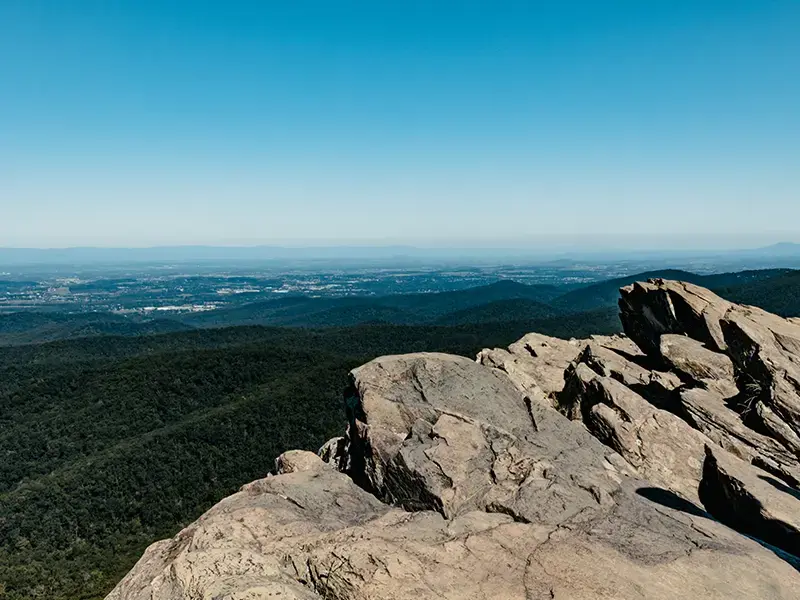
“Hike” may undersell the first mile. Humpback Rocks is only about a mile to the overlook, but that mile is steep, rocky and pretty determined to make you earn it. The payoff is an exposed rock outcrop looking across the Rockfish and Shenandoah valleys. Simply stunning.
Maybe it’s the bike-tour guy in me again, but I don’t mind when the best part of an outing requires a little work first. In fact, I usually prefer it that way. You remember the view a little differently when your legs had something to do with getting you there.
Figure roughly two miles round trip and somewhere between 1½ and three hours, depending on your pace and how long you decide to sit at the top.
If you want a classic Blue Ridge payoff without giving up most of the day, this is the one I’d look at first. Just don’t confuse short with easy.
Best by: Car + walk | Plan for: 1½–3 hours | Admission: Free | Budget: $0 per person, not including transportation or snacks
24. Look for Chainsaw-Carved Bears at Ragged Mountain
Ragged Mountain would make the list even without the wooden animals (you read that right).
The protected area covers roughly 980 acres around a 170-acre reservoir, and its seven-mile Lake Front Loop works through rocky bluffs, ravines, switchbacks and more than 1,000 feet of total elevation change.
Then the trail starts dropping surprises into the woods. Chainsaw-carved bears, eagles, owls and a figure known as the "Mountain Man," all worked into tree stumps. There's even a floating footbridge across one inlet.
I love that combination on paper. You're out for a real hike around a reservoir, and somebody has apparently decided the woods also need an owl carved into a stump.
Swimming and pets are prohibited to protect the reservoir's water quality.
Best by: Car + walk | Plan for: About 3–4 hours | Admission: No fee listed in our source | Budget: About $0 per person, not including transportation or hiking snacks

25. Take the Easier Route Toward Monticello
Not every good walk around Charlottesville needs to leave your legs filing a complaint.
The Saunders-Monticello Trail is the easier alternative to Humpback Rocks or Ragged Mountain, and I like it for exactly that reason. You still get woods, ravines, boardwalks, seasonal streams and overlooks, but the trail climbs gradually instead of trying to prove something to you.
The out-and-back route is about four miles through the Kemper Park/Monticello area, with grades kept near five percent. It’s free, works for walkers and regular bicycles, and was designed to be considerably more accessible than most regional nature trails.
This is the one I’d pick when I still want to move, but I don’t necessarily want the hike to become the whole story.
One practical note for cyclists: regular bikes are allowed, but e-bikes are not.
Best by: Car + walk or bike | Plan for: 1½–2 hours | Admission: Free | Budget: $0 per person, not including transportation or snacks
26. Walk Through Ivy Creek, Then Learn Who Lived There
At Ivy Creek, the trails are only half the reason to visit.
The 219-acre property has woods, fields, wetlands and several miles of walking routes, but it also preserves River View Farm and the story of Hugh Carr. Carr, formerly enslaved, purchased 58 acres here in 1870 and built a successful family farm that eventually grew much larger.
His daughter Mary Carr Greer became principal of Albemarle Training School. His son-in-law Conly Greer became Albemarle County's first Black agricultural extension agent and designed the 1930s Sanitary Barn that still stands on the property.
A roughly three-quarter-mile paved route makes the main area more accessible, while the farther trails get rougher.
Read about the Carr and Greer families before you head farther onto the trails.
Best by: Car + walk | Plan for: 1–3 hours | Admission: Free | Budget: $0 per person, not including transportation or snacks
27. Let Everyone Choose Their Own Version of Walnut Creek Park
Walnut Creek is where I'd send a group that wants to be outside but can't agree on what "outside" means.
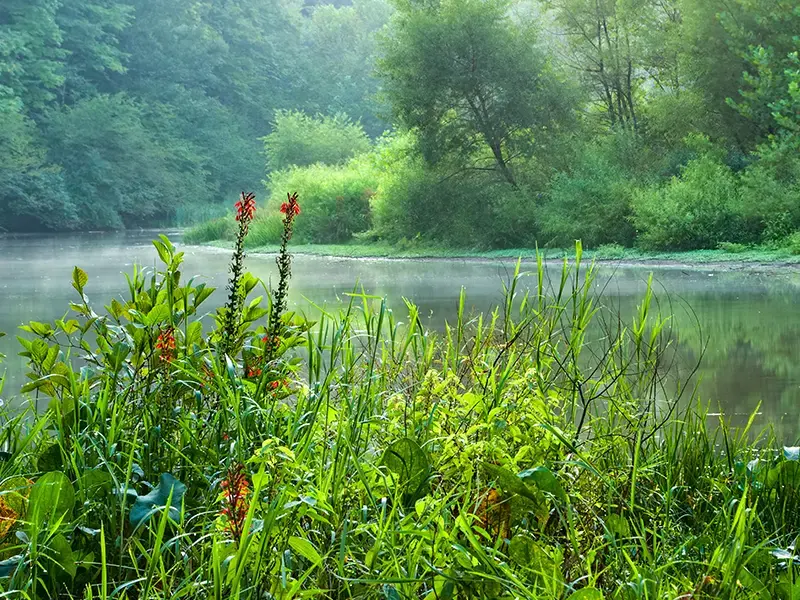
The park spreads across roughly 525 acres around a 45-acre lake. There are about 13 miles of trails, an 18-hole disc-golf course, fishing, a swimming beach, playgrounds and seasonal paddling.
In summer, the water is the obvious draw. Spring and fall make hiking and disc golf more comfortable.
One person can hike, another can play disc golf, and in summer somebody else can head for the water.
Best by: Car | Plan for: 2–4 hours | Admission: Free for general use | Budget: $0 per person, unless you rent equipment or reserve a shelter
One Last Charlottesville Planning Tip
If I were planning a Charlottesville weekend from this list, I'd organize the days by geography instead of trying to work downward from #1.
Monticello, Michie Tavern, Highland and Carter Mountain fit naturally together. UVA, Poe's room and nearby museums form another cluster. Downtown can take you from a morning market to dinner and live music without much transportation at all. Western Albemarle and the Blue Ridge deserve their own block of time.
And if you're spending roughly six hours riding through wine country with Shifting Gears, I'd treat that as the wine-country day rather than scheduling more wineries afterward… although you could definitely squeeze in one more if you’d like!
FAQs
What are the best things to do in Charlottesville for first-time visitors?
For a first visit, I’d start with Monticello, the University of Virginia Lawn and Rotunda, the Historic Downtown Mall, and Charlottesville wine country. If you want something more active, add the Blue Ridge Tunnel, Humpback Rocks, or a Shifting Gears guided winery tour by bicycle. That combination gives you Charlottesville’s history, food, wine, architecture and Blue Ridge scenery without spending the entire trip inside museums.
How many days do you need in Charlottesville, Virginia?
Two to three days is a good amount of time for most Charlottesville trips. One day can cover Monticello, Michie Tavern, Highland and Carter Mountain. Another can focus on UVA and Downtown Charlottesville, while a third gives you time for wine country, a bicycle tour, hiking or the Blue Ridge Tunnel. If you only have a weekend, organize your itinerary by location instead of trying to see everything.
What are the best free things to do in Charlottesville?
Charlottesville has quite a few worthwhile activities that cost nothing. You can walk the UVA Lawn and Rotunda, Historic Downtown Mall, Saunders-Monticello Trail and Ivy Creek Natural Area, browse McGuffey Art Center and Kluge-Ruhe Aboriginal Art Collection, or explore Walnut Creek Park. In warmer months, Fridays After Five also brings free live music to Ting Pavilion.
Comments